
Table of Contents
PE rattan furniture is widely chosen for patios, hotels, resorts, cafés, restaurants, gardens, pool areas, and residential outdoor spaces. It offers the visual warmth of woven furniture while allowing manufacturers to create repeatable colors, flexible shapes, and outdoor-oriented structures.
However, two pieces of PE rattan furniture can look almost identical in a photograph and perform very differently after installation. The difference is usually hidden in the material formulation, frame, welding, weaving method, cushion system, coating, and quality-control process.
For importers, distributors, designers, hospitality buyers, and project contractors, the practical question is not simply, “Is it PE rattan?” The better question is:
What evidence shows that this PE rattan furniture is suitable for my environment, usage level, and repeat-order requirements?
This guide uses a failure-point approach. Instead of judging furniture only by appearance, it shows how to inspect the areas where outdoor woven furniture is most likely to fade, loosen, corrode, retain water, become uncomfortable, or arrive damaged. It is designed for buyers who need PE rattan furniture that can be reproduced consistently for commercial, wholesale, or custom projects.
What PE Rattan Furniture Actually Means

PE stands for polyethylene, a family of thermoplastic polymers used in many manufactured products. In outdoor furniture, polyethylene can be extruded into strips, cords, or profiles that imitate the appearance of natural rattan.
The word “wicker” describes a weaving method rather than one specific raw material. A useful background reference is the overview of wicker construction, while the polyethylene reference page explains the broader material family.
PE rattan furniture normally combines several components:
- Extruded polyethylene weaving strands
- A metal support frame
- Welded or mechanically joined structural parts
- Powder coating or another frame finish
- Cushions, fabric, foam, and zippers where required
- Feet, glides, fasteners, glass, or tabletops
- Cartons and protective packaging for shipment
This means the woven surface is only one part of the product. Strong rattan cannot compensate for weak welds. A corrosion-resistant frame cannot compensate for poor drainage. A comfortable cushion cannot solve unstable chair geometry.
A reliable evaluation therefore treats PE rattan furniture as an integrated outdoor furniture system.
Why “PE Rattan” Is Not a Complete Quality Specification
Many product descriptions stop at phrases such as “high-quality PE rattan,” “weatherproof wicker,” or “UV-resistant outdoor furniture.” These phrases are useful for marketing, but they are not measurable specifications by themselves.
The term PE rattan furniture does not automatically tell a buyer:
- Whether virgin, recycled, or blended resin is used
- Whether UV stabilizers are included
- How the pigment is added
- How thick or heavy the strand is
- Whether the strand becomes brittle after exposure
- Whether color can be repeated in the next production batch
- Whether the frame is aluminum, steel, or mixed construction
- Whether the coating reaches hidden joints and welds
- Whether the cushions drain and recover properly
- Whether the furniture has been tested under a relevant method
Before approving an order, convert broad claims into questions that can be answered with documents, samples, dimensions, test conditions, photographs, or inspection criteria.
A supplier does not need to provide the same solution for every project. A covered apartment balcony, a busy restaurant terrace, and a beachfront resort have different risks. The PE rattan furniture specification should follow the environment.
Quality Check 1: Confirm the Rattan Material and Outdoor Formulation
The first check is the composition and intended use of the woven strand.
Ask What the Strand Is Made From
Request a clear material declaration. The answer should distinguish polyethylene from PVC, natural cane, rope, and other synthetic weaving materials.
For exposed outdoor use, PE rattan furniture is generally selected because polyethylene strands can be produced with a non-porous surface and outdoor additives. However, performance still depends on the formulation and manufacturing control.
Ask About UV Stabilization
Sunlight can affect polymers through fading, chalking, embrittlement, cracking, and loss of flexibility. UV stabilizers and suitable pigments can improve resistance, but the phrase “UV protected” should not be treated as a complete test result.
Ask:
- Which component was tested: raw strand, woven panel, or finished product?
- Which test method was used?
- What lamp type and exposure cycle were used?
- What property was evaluated after exposure?
- What was the acceptance criterion?
- Does the tested formulation match the order?
The current ISO 4892-3 standard covers fluorescent UV exposure methods for plastic specimens using controlled radiation, heat, and water. ASTM G154 provides principles for operating fluorescent UV and water apparatus for material exposure.
These references are valuable, but a number of test hours should not be presented as a guaranteed number of outdoor years. Laboratory exposure helps compare controlled material changes; real performance also depends on climate, product geometry, stress, maintenance, and installation.
Examine Flexibility Rather Than Softness Alone
A good strand should bend around the furniture geometry without cracking, whitening, splitting, or creating sharp edges. It should also recover reasonably after normal deformation.
Extremely hard material may become difficult to weave around tight curves. Extremely soft material may stretch, flatten, or lose shape under tension. The correct balance depends on strand profile, furniture design, and intended use.
Quality Check 2: Inspect Strand Geometry, Thickness, and Color Control
PE rattan furniture can use flat strips, half-round profiles, round cords, multi-tone strands, or textured surfaces. None of these profiles is automatically superior. What matters is whether the profile is suitable for the design and remains consistent across the order.
Measure More Than One Location
Do not evaluate a strand from only one visible area. Inspect:
- Straight seat and back panels
- Armrest curves
- Corners
- Lower frame edges
- Areas near staples or fastening points
- Hidden undersides
- Intersections where the weave changes direction
Variations in width, thickness, or surface texture may create weak spots and make the finished furniture look inconsistent.
Check Color in Natural and Artificial Light
Color should be reviewed under more than one lighting condition. Dark brown, gray, beige, and mixed-tone PE rattan furniture may appear different under warehouse lighting, daylight, or warm hospitality lighting.
For repeat programs, ask the supplier to maintain:
- An approved master sample
- A color code or signed color board
- A retained production sample
- Batch records
- A defined tolerance for acceptable variation
A visually attractive first order is not enough if the next container arrives with a noticeably different tone.
Inspect Cut Ends and Surface Finish
The strand should not have sharp burrs, rough cut ends, exposed fastening points, or visible whitening where it bends. Run a protected hand over armrests and seat edges, because these are direct customer-contact areas.
Quality Check 3: Audit Weave Tension at Failure-Prone Areas
Weaving quality is one of the easiest features to see and one of the easiest to misunderstand. A very tight weave is not always better if it places excessive stress on the strand or frame. A loose weave may look relaxed at first but can shift, sag, or expose gaps during use.
The goal is controlled, consistent tension.
Focus on Stress Transitions
Failures often begin where the strand changes direction or passes over a small radius. Inspect:
- Front seat rails
- Armrest curves
- Backrest corners
- Leg transitions
- Ottoman edges
- Sofa module connections
- Table corners
- Areas near screws, clips, and staples
The weave should lie smoothly without cutting into itself. End points should be secured and hidden where possible.
Compare Symmetry
Place matching chairs side by side. Compare the pattern, spacing, alignment, edge finishing, and visual density. Inconsistent weaving can signal weak production control even when each chair is individually usable.
For PE rattan furniture intended for a hotel, restaurant, or retail program, visual consistency matters because products are displayed together.
Perform a Practical Load-and-Recovery Check
A sample should be used, not only photographed. Sit in the chair repeatedly, press the backrest, load the armrest normally, and inspect whether the weave shifts or remains permanently deformed.
This is not a replacement for a formal furniture test. It is a practical screening step that can reveal movement, noise, loose ends, unstable geometry, and uncomfortable pressure points before bulk production.
Quality Check 4: Verify the Frame Beneath the Weave
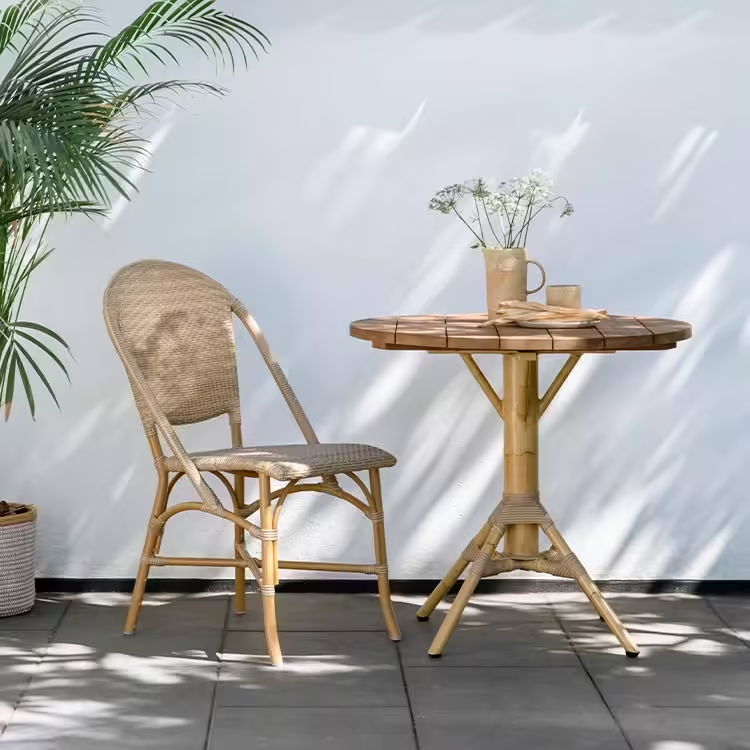
The frame carries the structural load. PE rattan furniture may use aluminum, treated steel, or a combination of materials, depending on the design, market, and application.
Do Not Accept “Metal Frame” as the Final Specification
Ask for:
- Frame material
- Tube dimensions
- Wall thickness where relevant
- Reinforcement locations
- Welding method
- Surface treatment
- Coating process
- Fastener material
- Adjustable-foot or glide details
Aluminum is widely used because it is lightweight and resistant to red rust, making it practical for furniture that staff must move frequently. Steel can provide strength and design flexibility, but it requires suitable corrosion protection, especially around welds, drilled holes, and damaged coating areas.
Inspect Welds Before They Are Hidden
Where possible, request frame photographs before weaving begins. Once PE rattan furniture is fully woven, many welds and reinforcements are difficult to inspect.
Look for:
- Continuous and appropriately finished welds
- No sharp projections
- No visible cracks
- Balanced left and right geometry
- Reinforcement at high-load joints
- Smooth transitions that will not cut the strand
- Proper cleaning before coating
Check Stability on a Flat Surface
A chair or table should stand evenly without rocking under normal conditions. Adjustable feet may help on slightly uneven floors, but they should not be used to hide a twisted frame.
For sofa modules, check connection points and alignment. For dining sets, confirm that chair arms, tabletop supports, and floor glides do not interfere with normal use.
The outdoor furniture collection shows several frame and weave combinations, including chairs, dining sets, sofas, and lounge furniture. Buyers should compare construction details by product type rather than applying one specification to every design.
Quality Check 5: Evaluate Coating and Corrosion Risk by Environment
A frame may look perfect when new but still contain weak points at welds, corners, fastener holes, and internal tube openings.
Match the Coating Requirement to the Site
Ask where the PE rattan furniture will be installed:
- Covered urban balcony
- Open restaurant terrace
- Humid garden
- Poolside area
- Rooftop
- Coastal resort
- Desert climate
- Seasonal outdoor venue
A coastal or poolside project usually requires more attention to corrosion pathways than a covered inland patio.
Understand What Salt Spray Testing Can and Cannot Show
The current ISO 9227 standard describes salt spray test procedures used to assess corrosion resistance and detect coating discontinuities. The standard also states that salt spray testing should not be used by itself to rank materials for long-term corrosion resistance or predict real service life.
Therefore, buyers should not compare two suppliers only by asking which one claims more salt spray hours. They should also compare:
- Substrate material
- Surface preparation
- Coating type
- Coating continuity
- Weld treatment
- Edge coverage
- Fasteners
- Drainage
- Product design
- Actual project environment
A meaningful requirement combines a relevant test method with agreed acceptance criteria and physical inspection.
Inspect Hidden Water Traps
Check whether water can enter hollow tubes, collect under caps, remain beneath glass, or stay inside cushion platforms. Drain holes should be positioned and finished so they release water without weakening the structure or creating sharp edges.
Quality Check 6: Test the Cushion as a System
Many PE rattan furniture complaints are actually cushion complaints. A good frame and weave can be undermined by fabric that fades, foam that collapses, covers that are difficult to remove, or construction that traps water.
Separate Four Cushion Questions
Evaluate the cushion by component:
- Fabric: resistance to light, abrasion, staining, and cleaning
- Foam: support, recovery, density, and water behavior
- Cover construction: stitching, zipper, seam placement, and fit
- Base design: ventilation, drainage, attachment, and movement control
Use Comfort Testing That Reflects the Project
A residential lounge sofa may prioritize deep comfort. A restaurant chair may need faster entry and exit, firmer support, and easier cleaning. A hotel pool lounger may need quick drainage and secure cushion attachment.
Ask several users to sit on the sample for a realistic period. Check:
- Seat height
- Seat depth
- Back angle
- Armrest height
- Pressure behind the knees
- Cushion recovery
- Sliding
- Heat buildup
- Ease of standing up
The Outdoor PE Rattan Sofa illustrates a lounge-oriented configuration, while the Outdoor Rattan Armchair represents a more compact seating format. These product types require different comfort and structural priorities.
Confirm Cleaning and Replacement Practicality
For commercial PE rattan furniture, removable covers and replaceable cushions can be more valuable than a complicated decorative cushion that is difficult to maintain.
Ask whether replacement covers, foam inserts, feet, caps, and connectors can be reproduced after the initial order.
Quality Check 7: Evaluate Ergonomics, Movement, and Daily Operation
Furniture quality is not only durability. It is also how the product behaves during everyday operation.
A café chair may be moved many times per day. A resort sofa may be rearranged for events. A rooftop project may require furniture that is light enough for staff to handle but stable enough for the location.
Check Operational Details
Evaluate:
- Product weight
- Grip points for lifting
- Stackability where applicable
- Floor-glide durability
- Noise when moved
- Clearance around table legs
- Module connectors
- Cushion attachment
- Cleaning access
- Replacement-part access
Avoid Designing Only for the Product Photograph
Large curves, deep seats, wide armrests, and thick cushions may look impressive, but they can reduce seating capacity, complicate container loading, block service paths, or create maintenance problems.
PE rattan furniture should be evaluated in the actual floor plan. Mark the furniture footprint, chair pull-out space, staff route, guest route, and cleaning access before finalizing dimensions.
For more planning factors, the commercial outdoor rattan furniture buyer guide provides a broader overview of project environment, materials, and supplier selection.
Quality Check 8: Control Bulk-Order Consistency

A sample proves that one piece can be made. It does not prove that hundreds of pieces can be made consistently.
Bulk PE rattan furniture programs should control variation in:
- Rattan color
- Strand profile
- Weave density
- Frame dimensions
- Welding
- Coating tone and gloss
- Cushion dimensions
- Fabric direction
- Stitching
- Hardware
- Feet and caps
- Carton labeling
Create a Golden Sample
The approved golden sample should be signed or otherwise formally identified. It should include all approved materials, colors, dimensions, comfort decisions, labels, and packaging details.
Photographs are helpful, but photographs alone are not enough. Lighting and camera processing can hide color and texture differences.
Define Inspection Checkpoints
A practical production plan may include:
- Raw-material confirmation
- Frame inspection before coating
- Coating inspection before weaving
- First woven unit approval
- First cushion approval
- In-line production inspection
- Pre-shipment inspection
- Container-loading check
Protect Repeat Orders
Ask how the supplier records the approved PE rattan furniture specification for future production. Repeat-order control may require retained color samples, material codes, drawings, bills of materials, packaging specifications, and approved supplier records.
This is especially important for hotels and restaurant chains that may expand or replace individual pieces later.
Quality Check 9: Inspect Packaging Before Approving Shipment
Packaging is part of product quality. A well-made chair can arrive damaged if the carton, stacking method, hardware protection, or loading plan is inadequate.
Check Contact Points
Inspect where products touch each other inside the carton. Protect:
- Armrest edges
- Legs
- Coated corners
- Glass
- Woven surfaces
- Cushion fabric
- Adjustable feet
- Connectors
- Exposed hardware
Soft protection should not leave marks or transfer color. Hard parts should not press directly against woven surfaces during vibration and compression.
Review Assembly Risk
For knock-down PE rattan furniture, confirm:
- Hardware completeness
- Hardware labeling
- Tool requirements
- Instruction clarity
- Hole alignment
- Thread quality
- Maximum tightening guidance
- Spare hardware policy
Perform an assembly trial using packaged production parts, not only prototype parts.
Check Carton Identification
Cartons should be easy to match to the project, room, product, color, and component. Clear labeling reduces unloading and installation errors.
Buyers reviewing custom furniture services should include packaging, labeling, and replacement-part requirements at the design stage rather than after production is finished.
PE Rattan Furniture Project Environment Matrix
The following matrix helps translate site conditions into purchasing priorities. It also prevents buyers from applying the same PE rattan furniture specification to every climate and commercial setting.
| Project Environment | Main Risks | Priority Checks | Useful Questions |
|---|---|---|---|
| Covered balcony | Dust, occasional moisture, limited space | Dimensions, comfort, easy cleaning | Can the footprint and cushion depth be customized? |
| Open restaurant terrace | Frequent movement, spills, UV, cleaning | Stable frame, glides, weave edges, removable covers | How will the chair perform under daily rearrangement? |
| Hotel garden | Appearance consistency, guest comfort, weather | Color control, ergonomics, drainage, replacement parts | Can future replacement pieces match the approved finish? |
| Poolside area | Water, chemicals, wet users, strong sunlight | Drainage, corrosion control, quick-drying cushion system | Where can water collect inside the product? |
| Coastal resort | Salt exposure, humidity, wind | Frame substrate, coating, fasteners, protected joints | What corrosion-control process is used at welds and openings? |
| Rooftop | Wind, movement, access limitations | Stability, weight, modularity, installation planning | How will the furniture be secured or managed in high winds? |
| Retail or distributor program | Repeat orders, multiple markets | Batch records, packaging, spare parts, consistent colors | How is the specification retained for later orders? |
This matrix is not a universal standard. It is a starting point for writing a project-specific specification.
How to Approve a PE Rattan Furniture Sample
A PE rattan furniture sample review should follow a repeatable sequence rather than relying on appearance alone.
Step 1: Confirm Documents
Review the drawing, bill of materials, dimensions, color references, fabric selection, cushion structure, hardware, and packaging concept.
Step 2: Inspect Appearance
Check color, weave alignment, symmetry, coating, sewing, glass, labels, and visible finish.
Step 3: Measure Critical Dimensions
Measure the seat, back, armrests, overall footprint, frame alignment, cushion thickness, and table clearance.
Step 4: Use the Furniture
Sit, stand, lean normally, move the product, connect modules, remove cushions, clean a small area, and assemble any knock-down components.
Step 5: Inspect Hidden Areas
Turn the furniture over. Check welds, feet, caps, drainage, strand fastening, exposed hardware, and areas likely to contact the floor or packaging.
Step 6: Compare With the Project Environment
Confirm that the sample solves the actual site risks. A sample can be well made and still be unsuitable for a humid coastal site, a narrow café, or a high-turnover restaurant.
Step 7: Record Every Approval
Use photographs, signed samples, measurements, comments, and acceptance criteria. Verbal approval is difficult to enforce during bulk production.
Questions to Put in a PE Rattan Furniture RFQ
A detailed request for quotation helps suppliers understand the project and reduces later changes.
Include:
- Product type and estimated quantity
- Indoor, covered outdoor, or exposed outdoor use
- Installation country and climate
- Residential or commercial usage
- Frame material requirement
- Rattan material and color
- Strand profile
- Cushion fabric and foam expectations
- Product dimensions
- Load and stability requirements
- Stackable, modular, or knock-down needs
- Applicable test methods
- Inspection requirements
- Labeling and packaging requirements
- Replacement-part requirements
- Sample approval process
- Delivery and loading constraints
- Drawings, reference images, or floor plans
Avoid requesting “best quality” without defining what quality means for the project. A precise RFQ creates better technical comparisons and helps prevent suppliers from quoting different PE rattan furniture constructions under the same general description.
Common Red Flags Buyers Should Not Ignore

Vague Material Language
“Plastic wicker,” “rattan style,” or “weatherproof material” without a clear composition should trigger follow-up questions.
Test Reports Without Product Traceability
A report is less useful when the buyer cannot confirm that the tested formulation, color, coating, or frame matches the order.
Perfect Front Views but No Underside Photos
Ask for images of welds, drainage points, fastening areas, and packaging contact points.
Different Specifications Across Documents
The quotation, product drawing, sample label, invoice description, and packing list should not describe different materials or dimensions.
A Sample That Cannot Be Reproduced
A supplier should explain how colors, rattan profiles, cushions, and components will be controlled during bulk production and repeat orders.
Generic Claims About Outdoor Lifespan
Real service life depends on climate, exposure, cleaning, usage, design, installation, and maintenance. Ask for verifiable specifications rather than a broad number of years.
FAQ
Is PE rattan furniture suitable for full outdoor use?
It can be suitable for exposed outdoor use when the woven material, frame, coating, cushions, drainage, and construction are designed for the environment. Buyers should not judge suitability from the rattan material alone.
Is PE rattan the same as wicker?
PE rattan describes a polyethylene weaving material. Wicker describes the weaving technique. PE rattan furniture is therefore a type of synthetic wicker furniture.
How can I tell whether PE rattan furniture is high quality?
Check the material declaration, UV stabilization evidence, strand consistency, weave tension, edge finishing, frame construction, welding, coating, cushion system, stability, production records, and packaging.
Is aluminum always better than steel for the frame?
Not in every design. Aluminum is lightweight and resistant to red rust, while properly treated steel can provide strength and design flexibility. The correct choice depends on structure, coating, project environment, weight, and maintenance expectations.
Does a UV test prove how many years the furniture will last?
No. Accelerated exposure tests can show material changes under defined laboratory conditions, but they do not directly guarantee a specific outdoor lifespan. Confirm the method, specimen, cycle, evaluated property, and acceptance criteria.
Why does PE rattan furniture become loose?
Possible causes include low weave tension, uneven strand properties, weak fastening, large unsupported spans, excessive heat, poor frame geometry, or repeated overload. Inspect the weave and frame as one system.
What should buyers check before placing a bulk order?
Approve a complete sample, lock the specification, define inspection checkpoints, confirm packaging, record color standards, and verify how the supplier will control repeat production.
Can PE rattan furniture be customized?
Many designs can be customized in rattan color, frame finish, dimensions, cushions, fabric, weaving pattern, packaging, and labeling. Feasibility should be confirmed during sample development. Buyers can contact the project team with drawings, quantities, target use, and installation conditions.
Conclusion
PE rattan furniture should not be purchased from photographs and generic weather-resistant claims alone. The most reliable buying process examines the complete product: material formulation, strand profile, weaving, stress points, frame, welds, coating, cushion behavior, ergonomics, bulk consistency, and packaging.
The strongest PE rattan furniture specifications are environment-specific. A covered balcony does not need the same controls as a coastal resort, and a residential sofa does not face the same operating demands as restaurant seating.
Before approving production, convert every important claim into a measurable requirement or inspection point. Confirm what will be tested, what will be visually checked, what will be retained as the golden sample, and how replacement or repeat-order consistency will be managed.
Buyers comparing PE rattan furniture for a commercial or custom project can review the available rattan furniture products and submit project requirements through the contact page. Providing the intended environment, dimensions, quantities, and performance priorities will support a more accurate product recommendation.
